Many Indian service firms work for clients abroad. Exports of services are "zero-rated" under GST: you can supply them without charging GST, as long as the conditions are met and you've filed a Letter of Undertaking (LUT).
This is general guidance. GST rules are detailed and change from time to time; confirm your position with your tax adviser.
When is a service an export?
Broadly, a supply of services is an export when:
- you (the supplier) are in India;
- the recipient is outside India;
- the place of supply is outside India;
- you receive payment in convertible foreign exchange (or in Indian rupees where RBI permits);
- you and the recipient are not merely establishments of the same person.
Two ways to export
- Under LUT, without paying IGST. The most common option for service firms.
- Paying IGST and claiming a refund. Ties up cash until the refund arrives.
Filing the LUT
The LUT is filed online on the GST portal each financial year, before you make export supplies under it. Keep the acknowledgement reference: many firms print it on export invoices.
The export invoice
An export invoice under LUT should show, among the usual details:
- the recipient's name and address outside India;
- the currency and, typically, the value in rupees;
- a statement that the supply is meant for export under LUT without payment of IGST.
Proof of payment
Keep evidence that payment was received in foreign exchange: bank advice, FIRA, or an eBRC, as applicable. Your adviser will want it, and so might a GST officer.
Common mistakes
- Forgetting to renew the LUT for the new financial year.
- Charging IGST to overseas clients when an LUT is in place.
- Treating services to an Indian branch of a foreign company as exports.
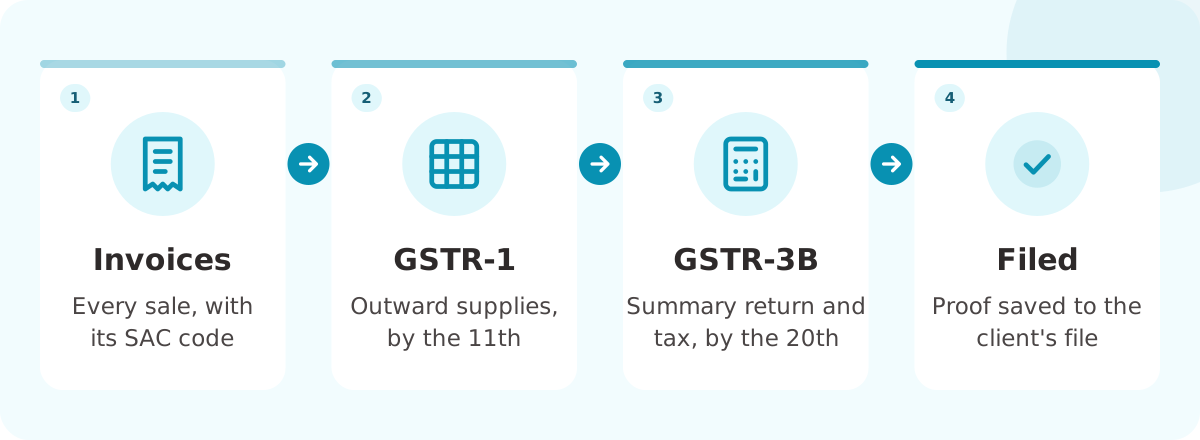
- Not reporting export invoices correctly in GSTR-1.
How MSMEPulse helps
In MSMEPulse, invoices to overseas clients in foreign currency use the export treatment automatically, print your LUT reference, record the exchange rate, and appear in the right place in your GST reports. Payments can be recorded in the invoice currency, and the reports show income in rupees.